
Enterprise AI Integration: The Real Production Bottleneck
If your AI pilot works but never ships, the gap isn't intelligence; it's enterprise AI integration, and here's how Trinity, Toyota, and Walmart closed it.
For every 33 AI proofs of concept enterprises launch, only 4 ever reach production.
The blocker is usually weak enterprise AI integration, not the intelligence of an AI model.
Leading enterprises like Trinity, Toyota, and Walmart have each closed the gap differently: unifying data, bridging legacy mainframes, and wiring AI into execution.
At the end of 2023, two teams at a Morgan Stanley hackathon started chasing the same ghost: millions of lines of aging legacy code, written in languages older than some of the engineers in the room. It was the kind of decades-old problem no one expected to crack over a weekend.
But those prototypes grew into DevGen.AI, a tool that translates legacy code into plain-English specs that engineers can rewrite in modern languages. Within months of launch, it had saved the firm's developers roughly 280,000 hours. What made that possible wasn't a smarter model. It was integration.
Without naming it, those hackathon teams had answered the question that decides most AI projects. What is enterprise AI integration? For Morgan Stanley, it meant connecting the model to the code and systems the business already ran on.
The burden the bank carried is a familiar one. Its systems still run on decades-old code in languages like Perl and COBOL, which slows modernization, widens security exposure, and grows harder to maintain each year as the engineers who wrote it retire and take their knowledge with them.
Commercial AI coding tools could generate new code, but legacy systems and the company-specific logic within them proved too much. Intelligence was never the constraint. The missing piece was the connection between the model and Morgan Stanley's own code.
Early in 2024, Trevor Brosnan, Global Head of Technology Strategy, Architecture, and Modernization, pulled some of the firm's top engineers into a small applied AI group with one mandate: build that connection.
Five months after DevGen.AI's January 2025 launch, it had worked through 9 million lines of code across 15,000 developers.
"The reality is we have so much modernization work to do, and we have ongoing demand from all of our businesses to deliver more functionality, more capability for our clients."
—Trevor Brosnan, Global Head of Technology Strategy, Architecture, and Modernization, Morgan Stanley
Every large enterprise carries a backlog like that. What set Morgan Stanley apart wasn’t a smarter model but the decision to connect AI to its existing systems before scaling. That connection is what enterprise AI integration really means, and skipping it is why most AI pilots never reach production.
In this article, we’ll break down why enterprise AI stalls in production and the three connections an enterprise has to build to get there.
Why Only 4 of 33 Enterprise AI Projects Reach Production
Morgan Stanley's breakthrough is easy to attribute to its engineering talent, its resources, or the sheer scale of a global bank. But the evidence points to something simpler: companies moving beyond AI pilots are making different decisions before the first deployment begins.
Adoption was never the hard part. Across enterprises, only 4 of every 33 AI proofs of concept reach production. Most stalls in the gap between a successful demo and a working deployment aren't due to the model falling short, but to the data, systems, and processes around it not being ready.
The problem gets harder as AI grows more autonomous. In McKinsey's 2025 State of AI survey, only about 23% of organizations reported scaling an agentic AI system in even one business function.
The survey's breakdown by function tells a sharper story: across every individual business function, no more than about 10% of organizations reported having scaled AI agents. The chart below, mapping agent deployment function by function, makes the pattern plain: adoption is broad, but scaled AI production is rare almost everywhere.
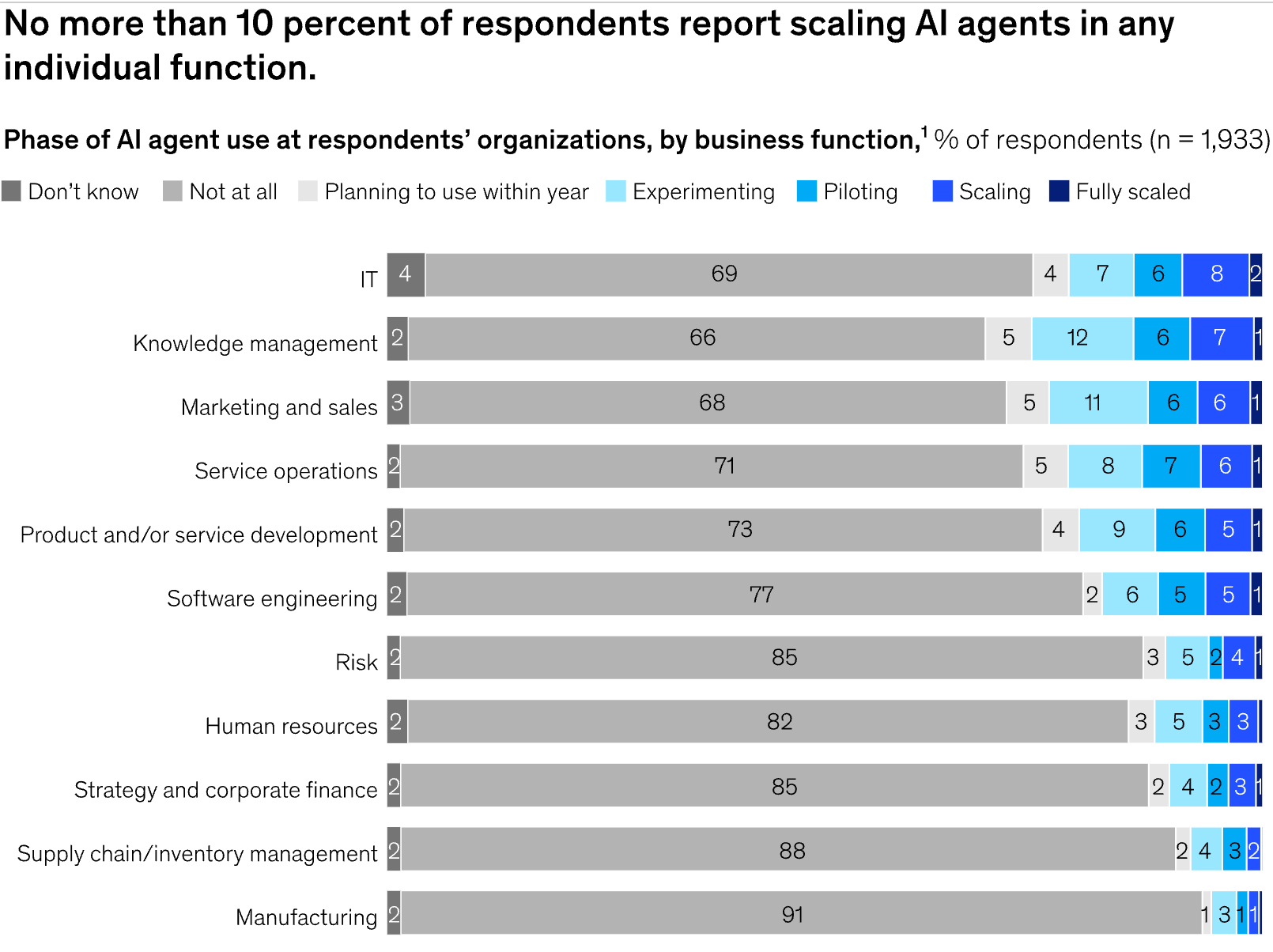
That gap isn’t a temporary lag. Gartner expects more than 40% of agentic AI projects to be canceled by the end of 2027, undone by rising costs, unclear returns, and weak controls. The models are capable. The environments they land in aren’t.
"AI is forcing organizations to rethink how identity, access, and infrastructure interact because legacy environments were never designed for autonomous systems operating at scale. Companies must redesign their control layers to match the speed and autonomy AI introduces."
—Sumit Dhawan, CEO, Proofpoint
The organizations breaking that pattern aren’t using fundamentally different models. They redesign the workflow around AI rather than bolting it onto the systems they already run, and McKinsey finds they are nearly three times as likely to take that structural step as the companies still stuck in pilots. What separates them isn’t the model's intelligence. It is the decision to rebuild around it.
Why Enterprise AI Stalls: 3 Integration Gaps Explained
In a 2026 survey of more than 2,000 executives, 68% said they worry that their AI implementation efforts will fail due to a lack of integration with core business activities. The intent is there; the connection isn't.
That gap is easy to misread. The model gets blamed, the data gets blamed, or the budget gets blamed. In most cases, the real barrier is enterprise AI integration; the AI is never fully connected to the systems, data, and workflows the business already depends on. Without that connection, even a capable model stays isolated from the business it is meant to improve.
Here are the three AI enterprise integration gaps that explain why most AI stalls before production:
- Fragmented Data the AI Can’t Reach: The information the AI needs usually exists somewhere in the business, but it sits in disconnected systems with no unified layer between them. The model ends up working from a partial or stale picture, and its outputs become hard to trust. In fact, 8 in 10 companies cited data limitations as a roadblock. Many teams paper over the problem with manual workarounds to stitch fragmented data together, but those break the moment AI has to operate at scale. Without a common data foundation, AI systems can technically run, but the right answer stays out of reach. The fix isn't a smarter model. It's a connective data layer that the AI can actually read.
- Legacy Systems With No Way for AI to Plug In: Many enterprises still run on core systems built long before AI, with few or no modern interfaces for outside applications to connect through. Wiring AI in often means touching the systems the business depends on every day, so projects slow down or stop before they ever reach production. The problem is widely felt: in one 2025 research survey, nearly 60% of AI leaders named integrating with legacy systems as one of their organization's primary barriers to adopting agentic AI, precisely because that infrastructure is too rigid for autonomous agents to plug into. Without a reliable way to bridge AI with those systems, legacy system modernization stalls, and production deployments remain out of reach. The fix isn't to rip out the core. It's a bridge that lets AI reach the existing system without disrupting it.
- AI That Can Recommend but Can’t Act: Plenty of AI systems generate the right call and then stop there. A replenishment is suggested, a route is optimized, an order is flagged for review, but a human still has to key that decision into the system of record. At scale, the action lags the insight, and the loop never closes. The disconnect shows up in the numbers: while 64% of organizations say AI is driving innovation, only 39% report any enterprise-level EBIT impact from it. Without a direct connection between the AI and the operational systems that execute its decisions, recommendations rarely turn into measurable business outcomes. The fix isn't a better prediction. It's wiring the AI's decisions back into the systems that act on them.
How Trinity Industries Fixed Fragmented Data Before Scaling AI
When AI can only reach fragments of the business, its outputs become hard to trust. The fix isn't a more capable model. It's a unified data layer that every model, dashboard, and application can rely on, the connective foundation at the heart of enterprise AI integration.
Trinity Industries, one of North America's largest railcar manufacturers and lessors, employs roughly 6,110 people and manages 146,270 railcars across manufacturing, leasing, and logistics. Its analytics had sprawled into hundreds of dashboards and nearly 600 separate business measures that often gave conflicting answers to the same question, exactly the fragmented-data problem that keeps AI from reaching production. Teams were logging 11,000 hours a month working inside those dashboards.
So Trinity rebuilt the foundation before expanding its AI implementation. It migrated 95% of its enterprise data into a single lakehouse architecture, moved data transformations upstream, and retired legacy dashboards so every model, dashboard, and AI application drew from the same trusted source. The migration took nearly a year, followed by another six to eight months of stabilization.
That foundation is what made AI reliable enough to use across the business. Take Trinity's ETA prediction model: roughly 20% of the industry's railcar location data is misreported, so the model first pulls fragmented AEI-tag and GPS feeds into a single cleaned, real-time view before it runs.
Through Trinsight, a platform built with NTT DATA, Trinity now gives customers track-level visibility into railcar locations and freight status, and the same data foundation supports procurement agents in automating supplier communication and inventory tracking.
"Without a single data layer, organizations often face the 'which number is right?' dilemma, where data from different departments doesn't match."
—Stephen Ecker, Chief Data Officer, Trinity Industries
Those results show what a shared data foundation makes possible. Trinity's procurement agents now support more than $1 billion in manufacturing supply chain spending and have lifted on-time material delivery by 15%. The ETA model performs 50% better than industry benchmarks, and Trinity credits its analytics program with more than $100 million in business impact.
Once every model and agent worked from the same trusted source, the AI became accurate enough to act on and reliable enough to scale, closing the exact gap that leaves fragmented data out of reach.
Exploring Toyota's Agent Layer for Untouchable Legacy Systems
Legacy systems are often the biggest obstacle to enterprise AI integration. Connecting a modern model usually means modifying the systems a business relies on every day, a risk many organizations won't take. The alternative is to bridge the gap instead, letting AI work with legacy systems without changing them.
Toyota Motor North America faced exactly that obstacle across its supply chain and vehicle-tracking operations. Core processes still ran on decades-old mainframes, where tracking a single vehicle meant navigating 50 to 100 green-screen interfaces, and supply planning leaned on roughly 75 interconnected spreadsheets rebuilt by hand each month.
Rather than replace the mainframe, Toyota built an agent layer on top of it. The bridge reads directly from the legacy systems and surfaces the information through a modern interface, so teams get the data they need without ever logging into the mainframe, the exact "no way for AI to plug in" gap, solved without touching the core.
The gains went further than visibility. A new vehicle management tool replaced 50 to 100 mainframe screens with a single real-time view of every vehicle from production through dealer delivery. Building on that, AI agents can monitor shipment delays, notify logistics providers, update dealerships, and escalate exceptions only when human judgment is required.
"The agent can do all these things before the team member even comes in in the morning."
—Jason Ballard, Vice President of Digital Innovations, Toyota Motor North America
Bridging instead of replacing paid off in measurable ways. Supply planning that once tied up more than 50 team members across roughly 75 spreadsheets now runs with a focused team of just 6 to 10, with an AI agent delivering planning scenarios in minutes rather than the hours of overtime the old process once demanded.
Toyota never touched the mainframe. It built a bridge to it, and that bridge is what finally let AI reach the systems the business had depended on for decades. Once the legacy systems became accessible without being disrupted, AI could finally work with the systems the business already depended on.
Walmart's Move From AI Recommendation to Automatic Action
The first two gaps we discussed were about helping AI reach the business. This one is about what happens after the model makes the right call. A forecast, a recommendation, or an alert creates little value if a person still has to key it into the operational system. Walmart solved that last mile of enterprise AI integration by connecting AI directly to the workflows that execute decisions.
Walmart, the world's largest retailer, runs a supply chain spanning thousands of stores and fulfillment centers across multiple countries. Its AI could already spot stock imbalances, demand shifts, and operational disruptions, but surfacing those insights wasn't enough. At Walmart's scale, recommendations waiting on human action quickly fell behind the problems they were meant to solve.
The company closed that gap by wiring AI directly into its supply chain systems, so routine decisions are executed automatically while employees focus on exceptions rather than on every transaction.
"At this scale, the only way to move faster is to move smarter. From self-healing inventory to agentic AI, we're creating systems that turn real-time signals into real-time action, freeing up associates and delivering for customers."
—Vinod Bidarkoppa, Executive Vice President and Chief Technology Officer, Walmart International
The AI impact reached across operations. Self-Healing Inventory detects stock imbalances and automatically redirects inventory before shortages reach store shelves. AI forecasting continuously adjusts replenishment schedules as demand shifts, helping the supply chain flex around disruptions like weather without waiting for manual intervention.
In distribution centers, AI systems can flag equipment issues, recommend next steps, and automate routine responses. And Walmart's Trend-to-Product platform uses AI agents to feed emerging consumer demand straight into prototyping and sourcing, rather than handing a report to a merchandiser, moving popular ideas to shelves in as little as six weeks.
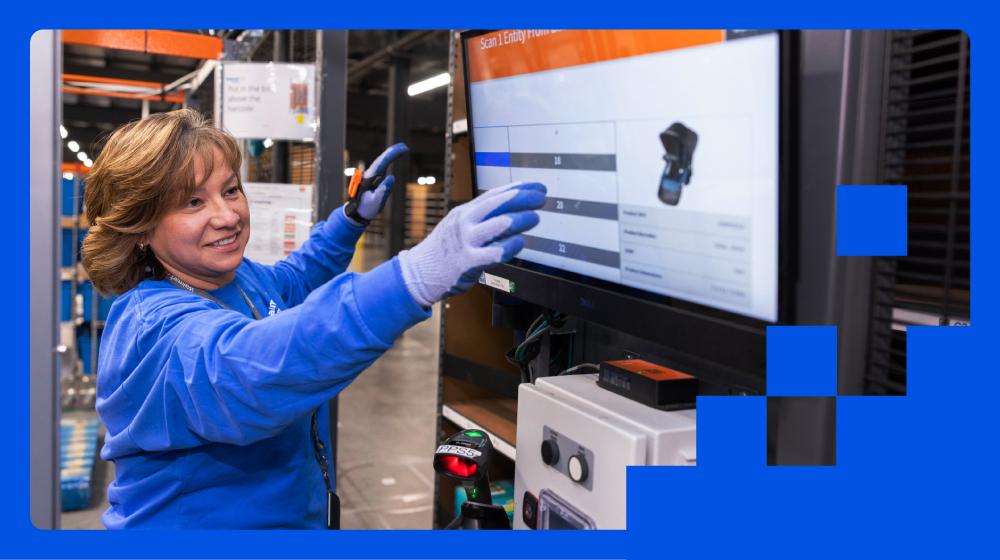
The same execution layer reaches frontline teams. An associate can ask, "What items were shorted in these stores?" and get not just an answer but recommended next steps wired to the systems that fulfill them, turning hours of analysis into seconds of action. The photo below shows what that shift looks like on the floor: an associate working alongside the automated systems that now make decisions the AI could only recommend.
The payoff came from closing that loop. Self-Healing Inventory has saved Walmart more than $55 million; its real-time AI supply chain now operates across Mexico, Canada, and Costa Rica; and product development cycles that once took months now finish in weeks.
For Walmart, the missing piece was never prediction. It was execution, connecting AI directly to the systems that act on its decisions. Once forecasts could automatically trigger replenishment, rerouting, and sourcing decisions, AI stopped acting as an adviser and became part of the operation itself, closing the exact gap where AI can recommend but can’t act.
The Decision That Separates Enterprise AI in Production From Pilots
Morgan Stanley didn't get AI into production by waiting for a smarter model. It got there by building the connection between AI and the systems its developers already relied on. The model wasn't the bottleneck. The missing AI enterprise integration layer was.
That connection is still rare. Only 11% of organizations are actively running agentic AI in production, even as 38% are piloting it. The gap isn't ambition or investment. It's whether the business has built the systems, data, and workflows that let AI move from recommendation to execution.
So the question for every leadership team still presenting AI pilots isn't which model to deploy next. It's whether the organization has done the harder work of enterprise AI integration.
.avif)
Frequent Asked Questions
What is agentic AI integration?
Agentic AI integration is the work of connecting AI agents, systems that act rather than just analyze, into enterprise workflows so they can take real actions within set limits, with humans handling the exceptions. Its value depends entirely on the integration, because an agent that can’t write back to the system of record can only advise.
How is AI being used in production?
In production, AI is shifting from advising humans to acting directly inside operational systems. For example, Walmart's Self-Healing Inventory automatically reroutes overstock before it becomes waste, saving more than $55 million, while its agentic tools wire an associate's question straight to the systems that fulfill it.
Why does enterprise AI stall in production?
Enterprise AI usually stalls because it was never properly connected to the systems the business depends on, not because the model was too weak. The ambition is there; nearly every organization plans to deploy advanced AI within a year, yet 58% admit they lack a well-defined data foundation to support it.
What is legacy system modernization?
Legacy system modernization means updating or extending older core systems, often decades-old mainframes, so modern AI can work with them, without necessarily ripping the old system out. This matters because as much as 70% of the software still running in large enterprises was built 20 or more years ago.
What is an AI implementation?
An AI implementation turns a promising pilot into a system that runs live in real business operations, not just a demo. The difference between the two comes down to connection. Trinity, Toyota, and Walmart all succeeded because they built that connective layer first, rather than reaching for a more capable model.


.svg)


_0000_Layer-2.png)

