
Rethinking Growth With AI Tools for Product Managers
AI tools for product managers are moving beyond dashboards. Discover how generative AI accelerates discovery, strengthens roadmaps, and delivers measurable speed and revenue gains.
Product managers face signal overload, with 48% struggling to balance reactive and proactive work. AI tools for product managers are becoming essential to manage scale and complexity.
Generative AI for product managers accelerates research and ideation. McKinsey estimates $60B in productivity gains in product research and design.
Teams using AI tools for product discovery report 40% higher productivity and 5% faster time to market, turning insight into execution advantage.
A few years ago, teams inside Nestlé were stuck in a familiar bottleneck. Packaging had to protect food and meet rising sustainability standards, yet finding materials that satisfied both could take years of research.
Instead of accepting those timelines, Nestlé partnered with IBM Research to reengineer the discovery process itself, aiming to create AI tools for product discovery that could accelerate the identification and evaluation of new packaging materials.
Their teams built a generative AI tool to identify novel high-barrier packaging materials, training a chemical language model on public and proprietary data and using a regression transformer to link molecular structure with physical and chemical properties.
The resulting system proposed entirely new materials that shield sensitive products from moisture, oxygen, and temperature swings, while accounting for cost, recyclability, and functionality.
“We do believe that Generative AI will continue to disrupt scientific discovery, impacting the core business of all knowledge-based industries, allowing critical differentiation and sustainable growth.”
— Alessandro Curioni, IBM Research Vice President Europe and Africa
This initiative is part of a broader digital transformation at Nestlé, which also includes recipe optimization tools, digital twins for manufacturing, and a new deep-tech R&D center focused on high-performing AI and automation.
What is happening inside Nestlé isn’t an isolated experiment. It reflects a significant shift in how leading enterprises are thinking about innovation, AI tools for product discovery, and generative AI for product managers.
In fact, McKinsey & Company estimates generative AI could add $2.6 trillion and $4.4 trillion annually to the global economy, much of it in R&D and product development.
For product leaders, the question is no longer whether to use AI, but how deeply it should shape the way products are built. How is AI used in product management today, and what does that mean for growth tomorrow?
In many organizations, AI tools for product managers still focus on productivity. However, the real opportunity lies in embedding AI into discovery, prioritization, and roadmap decisions.
In this article, we’ll explore how AI tools for product managers are evolving into engines of sustained growth.
The Real Product Management Problem Isn’t Data - It’s Decisions
Product management has become an exercise in compression. Customer feedback flows in from support tickets, reviews, NPS surveys, and sales calls. Product telemetry streams in real time. Competitive moves happen weekly.
Yet roadmaps still need to be set, defended, and delivered. Nearly half of product managers say their organizations primarily measure launch success through product metrics such as usage and adoption.
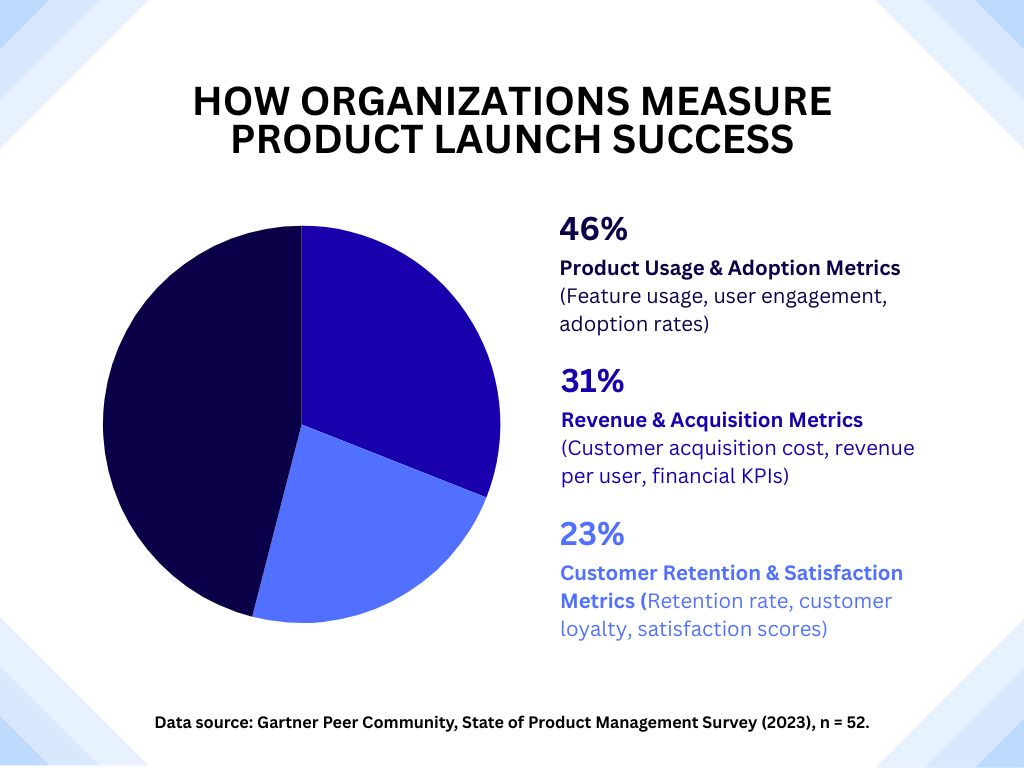
At the same time, the most common challenges include balancing reactive versus proactive work at 48%, competing priorities at 44%, and overwhelming time constraints at 38%. Product leaders are expected to deliver outcomes while navigating constant inputs.
Without AI, this work remains manual and cyclical. Teams tag feedback in spreadsheets, review dashboards periodically, and rely on meetings to reconcile competing narratives. The result is signal overload and roadmap debates shaped as much by internal influence as by customer evidence.
That pressure is what has fueled the hunt for the best AI tools for product managers. Leaders are no longer looking for marginal automation. They are searching for systems that turn scattered signals into defensible priorities.
AI tools for product managers can cluster thousands of feedback points in minutes, connect sentiment to behavioral analytics, and generate data-backed roadmap scenarios. More advanced systems move toward agentic AI, proactively surfacing risks, modeling trade-offs, and recommending sequencing decisions before bottlenecks appear.
The best AI tools for optimizing product visibility, AI tools for product discovery, and generative AI for product managers are really making an impact. Interestingly, product professionals using AI tools report a 40% increase in productivity and a 5% faster time to market. That shift turns periodic insight into continuous intelligence, reducing manual synthesis and freeing leaders to focus on strategic direction rather than reactive coordination.
AI Tools for Product Managers and the Shift to Faster Roadmap Decisions
AI tools for product managers are redefining product management by addressing long-standing challenges in ideation, prioritization, and continuous improvement.
Here’s a closer look at these issues:
- Problems With Product Ideation: Early-stage ideation often relies on scattered research and internal debate. AI tools reduce that friction by analyzing customer feedback, market signals, and historical data to quickly surface areas of opportunity. Teams can move from insight to validated concept faster and with stronger evidence. The impact is clear: McKinsey estimates generative AI could unlock $60 billion in productivity in product research and design alone, highlighting how significantly it can accelerate discovery.
- Lack of Roadmap and Market Signal Monitoring: Roadmaps often struggle to keep pace with shifting customer expectations and competitive moves. In fast-moving markets, delayed adjustments can weaken positioning and slow growth. AI tools for product managers address this by continuously analyzing market signals, customer behavior, and adoption data to inform sequencing and investment decisions in real time. The shift is already visible: about 44% of organizations are bundling generative AI into existing products, showing that product teams are embedding AI capabilities directly into their roadmaps to stay competitive.
- Product Optimization and Feedback Loops: Post-launch optimization is where many teams lose momentum. While 95% of companies have collected customer feedback for years, only about 10% use those insights to meaningfully change processes or improve customer experience. AI closes that gap by connecting behavioral data, sentiment, and operational metrics to identify what is actually driving adoption or churn. Instead of collecting feedback as a formality, product teams can translate it into continuous improvemet
Next, we’ll walk through real-world examples of enterprises applying AI tools for product management to solve the three core challenges discussed above: product ideation, roadmap and market signal monitoring, and post-launch optimization.
AI Tools Accelerating Product Ideation at P&G
Problems with product ideation rarely stem from a lack of data. More often, they come from the difficulty of turning scattered insights into clear, validated concepts.
The popular consumer goods corporation Procter & Gamble is an intriguing example of a company that has faced challenges in product ideation. The company experienced increasing difficulty generating product-innovation ideas. Even though they collect vast amounts of consumer, market, and operational data, the company still relied on traditional, slow methods. That changed in 2021.
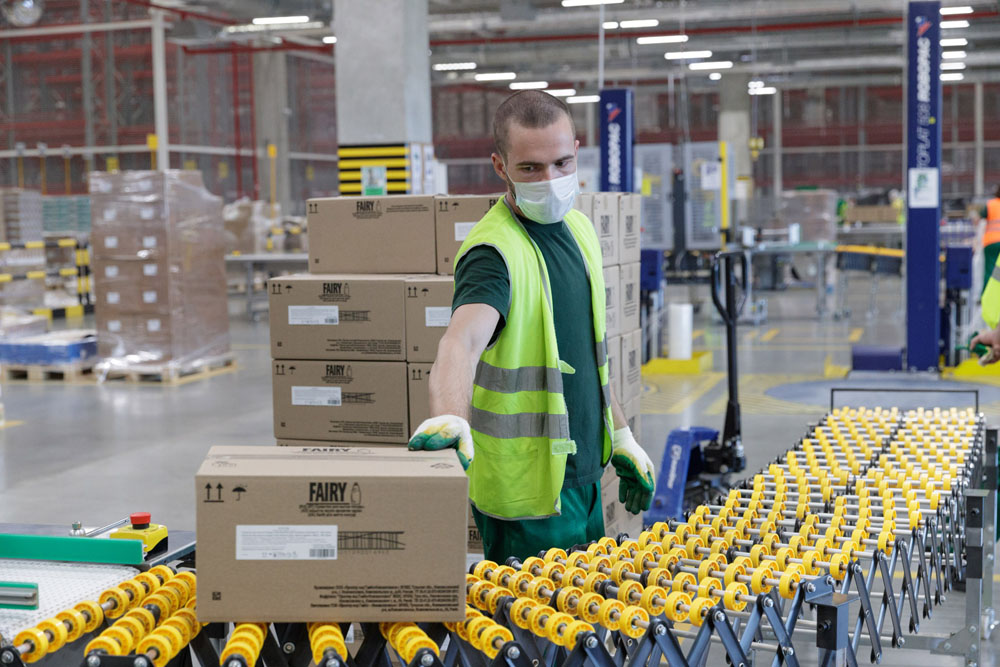
In 2021, Procter & Gamble created an ‘AI Factory’ to develop AI models for its operations, particularly in product management. Using this AI Factory system, the company created AI tools for product managers, such as the Great Idea Generator, to assist with ideation.
Their AI tool analyzed consumer trends and historical data to propose new products and marketing concepts, helping teams move from insight to product idea faster. Generative AI for product managers within the company also enabled them to explore data conversationally and test product concepts earlier in the innovation process.
“Consumers’ daily lives and their needs are constantly changing, and we want to make sure we have the right solutions for their needs. Technology helps us better understand consumer behaviors, quickly uncover emerging trends, and understand how to deliver superior experiences across our brands.”
- Michael Lancor, Vice President of Analytics & Insights at P&G.
By integrating AI tools directly into its product and R&D workflows, P&G reduced development and deployment cycles, cutting AI-driven product rollout time by months. For instance, the company developed the Perfume Development Digital Suite, an ecosystem of AI-powered, advanced data-processing tools that enable it to create new fragrances five times faster than before.
This AI-driven approach to ideation and experimentation accelerated product design, improved alignment with consumer preferences, and delivered measurable gains for the company. It shows how AI can move beyond analysis support to become an active partner in product creation.
How Unilever Uses AI to Act on Market Signals Faster
Keeping pace with rapidly shifting consumer preferences, cultural trends, and competitive signals is a core challenge in product management. When market monitoring is episodic and research cycles are slow, product roadmaps are built on outdated information, making it harder for teams to prioritize, sequence launches, and respond in time.
To stay competitive, product management must move from periodic planning to continuous market monitoring and faster iteration. That is the shift Unilever made, embedding AI directly into its systems to ensure roadmap and marketing decisions reflect real-time market signals rather than lagging insights.
For instance, Unilever used AI in its market intelligence and marketing systems to continuously monitor consumer conversations, sentiment, and trend signals across digital channels. Its network processes an average of 240 terabytes of data each week across more than 3 billion transactions, converting market noise into real-time input for product and roadmap decisions.
They also used AI-based digital twin technology, which created virtual replicas of physical products. The company connected AI insights directly to its digital product twins to quickly create and adapt product content based on what was resonating in the market. This helped close the gap between insight, idea generation, and action, making the overall product management process faster and more responsive.
“Our product twins can be deployed everywhere and anywhere, accurately and consistently, so content is generated faster and on brand. We call it creativity at the speed of life.”
- Esi Eggleston Bracey, Unilever’s Chief Growth & Marketing Officer.
Similar to P&G, Unilever also used AI tools for product ideation. Its Lynx AI Body Spray was developed using 46 terabytes of data, 6,000 ingredients, and 3.5 million potential fragrance combinations to create one unique scent.
As a result of using AI tools, Unilever shifted from reacting to trends to acting on early signals, allowing teams to innovate faster and stay relevant at scale. AI-powered content creation reduced Unilever’s production costs by up to 55% and cut turnaround times by about 65%, while helping ensure that products and roadmaps remained aligned with real-time market changes.
AI Tools Strengthening Product and Feedback Loops at Daily Harvest
Daily Harvest had to manage a growing product catalog, complex fulfillment operations, and a large volume of customer interactions, all with a small team. Relying on manual analysis made it difficult for them to identify customer pain points, predict churn, and continuously improve the product and delivery experience. This made it challenging to operate at the speed required for a subscription-based food business.
"We don't want customers to be fatigued with our food. We want them to try new products that we're launching or try things they've never tried so they can feel like the assortment is evergreen and it meets a bunch of different needs that they have throughout their life cycle."
- Jackson Mlawer, Head of Product & Technology at Daily Harvest.
The company integrated AI across its customer experience and operations to create faster feedback loops for product teams. Here, the AI tools for product managers analyze customer behavior and service interactions to personalize recommendations, identify subscribers who may be at risk of canceling, and detect recurring issues in support conversations. These tools also help optimize logistics decisions such as packaging, box size, and dry-ice usage.
As a result, the company improved customer retention through smarter product recommendations, reduced friction with AI-assisted support, and increased delivery reliability by optimizing shipping processes. In fact, AI software analyzed nearly 24,000 Daily Harvest orders and identified that more than 3,600 required product packaging improvements, allowing the team to address issues proactively and enhance the overall customer experience.
The Expanding Role of Generative AI for Product Managers
AI isn't sitting at the edges of product management. As Nestlé demonstrates, it can compress research cycles, widen the range of ideas explored, and ground decisions in data rather than instinct.
The momentum is clear. According to Gartner, 69% of product managers say increased use of data and AI is one of the aspects they are most excited about for the future. That enthusiasm reflects a broader shift already underway.
Across industries, AI tools for product discovery, prioritization, and optimization are moving teams from reactive dashboards to continuous intelligence. The role of AI is evolving from assistant to proactive teammate, shaping what gets built, when it launches, and how it performs. The opportunity now isn’t just adoption, but disciplined integration with the governance and oversight required to ensure AI strengthens, rather than distorts, product decisions.
.avif)


.svg)


_0000_Layer-2.png)


