
What the Chip Shortage Taught GM About AI in Procurement
AI in procurement is usually measured on savings. GM, Lenovo, and Schneider Electric show it can do something bigger, keeping supply and revenue intact when markets turn chaotic.
73% of companies lost money to supplier disruption last year, yet AI in procurement is still judged mainly on savings.
The real value of AI for supply chain optimization is protecting revenue by catching disruptions below tier one.
To protect supply, leaders can connect signals across systems, extend supplier risk monitoring past tier one, and route every AI alert to someone who can act.
In early 2026, within hours of conflict escalating in the Middle East, Nissan's supply chain team in the Americas knew which critical materials were exposed, including aluminum. Rather than waiting for shortages to emerge, the team could assess affected programs and start exploring alternative sources with suppliers. That speed came from AI in procurement built for visibility, not just savings.
Five years earlier, the same team was working without that capability. During the 2021 chip shortage, Nissan halted production for nearly three weeks. It could see its direct suppliers, but not the companies behind them. Gerardo de la Torre Garcia, who leads supply chain management for Nissan Americas, still remembers what that was like.
"I wish I had this level of visibility in 2021 when the semiconductor crisis happened. We were like blind, with no clear visibility on what was going on in the globe. Now we have a very immediate assessment."
—Gerardo de la Torre Garcia, Regional Senior Director of Supply Chain Management, Nissan Americas
The fix wasn't a procurement automation tool built to cut costs. The team built a database that maps its suppliers' suppliers down to tier five, originally to meet human-rights compliance rules. By May 2025, more than 94% of Nissan's manufacturing parts suppliers in the Americas had shared their supplier data.
AI came later. By mid-2025, the team was still running early trials through outside partners. Today, real-time alerts from AI-based risk intelligence firms are checked against Nissan's own supplier map. That kind of supplier risk monitoring now shows chip dependencies at lower-tier suppliers across vehicle programs, and Nissan says the program has helped it avoid substantial production losses from supplier cyber incidents.
The capability runs inside Re:Nissan, a recovery plan built on ¥500 billion in cost savings, with a 300-person office empowered to make cost decisions and more volume going to fewer suppliers. De la Torre Garcia calls resilience a core enabler of that plan.
Even so, it was a hard sell. Nissan Americas' IT director for manufacturing and supply chain says centralizing the data was hard to justify because the benefits wouldn't be immediate. He now calls it a "gold mine."
So what is AI in procurement in action? It applies machine learning and generative AI to sourcing, supplier management, and supply chain risk, and at Nissan, that meant catching disruptions below tier one within hours. It protected far more than cost, because a three-week production halt can result in cars that never get built and revenue that never arrives.
Yet procurement is still funded and measured on savings, and a savings metric has no line for a disruption that never happens. So the capabilities that protect revenue are the hardest to fund and the easiest to leave unfinished.
In this article, we'll look at the three challenges that keep AI in procurement from protecting revenue and growth, and how leading enterprises overcome them.
Why Is AI in Procurement Moving Faster Than Supply Visibility?
Supply continuity is now procurement's top priority, ahead of cost reduction, because it protects revenue and profitability. Recent shortages show why. When China halted Nexperia exports in late 2025, chips worth fractions of a penny cost Honda about 110,000 vehicles of North American production and led it to cut ¥150 billion (about $1 billion) from its profit forecast.
AI in procurement is spreading fast, but mostly in the work it speeds up. As the chart below shows, about 62% of teams report shorter cycle times from AI and 64% report productivity gains, while 63% report no spend savings at all.
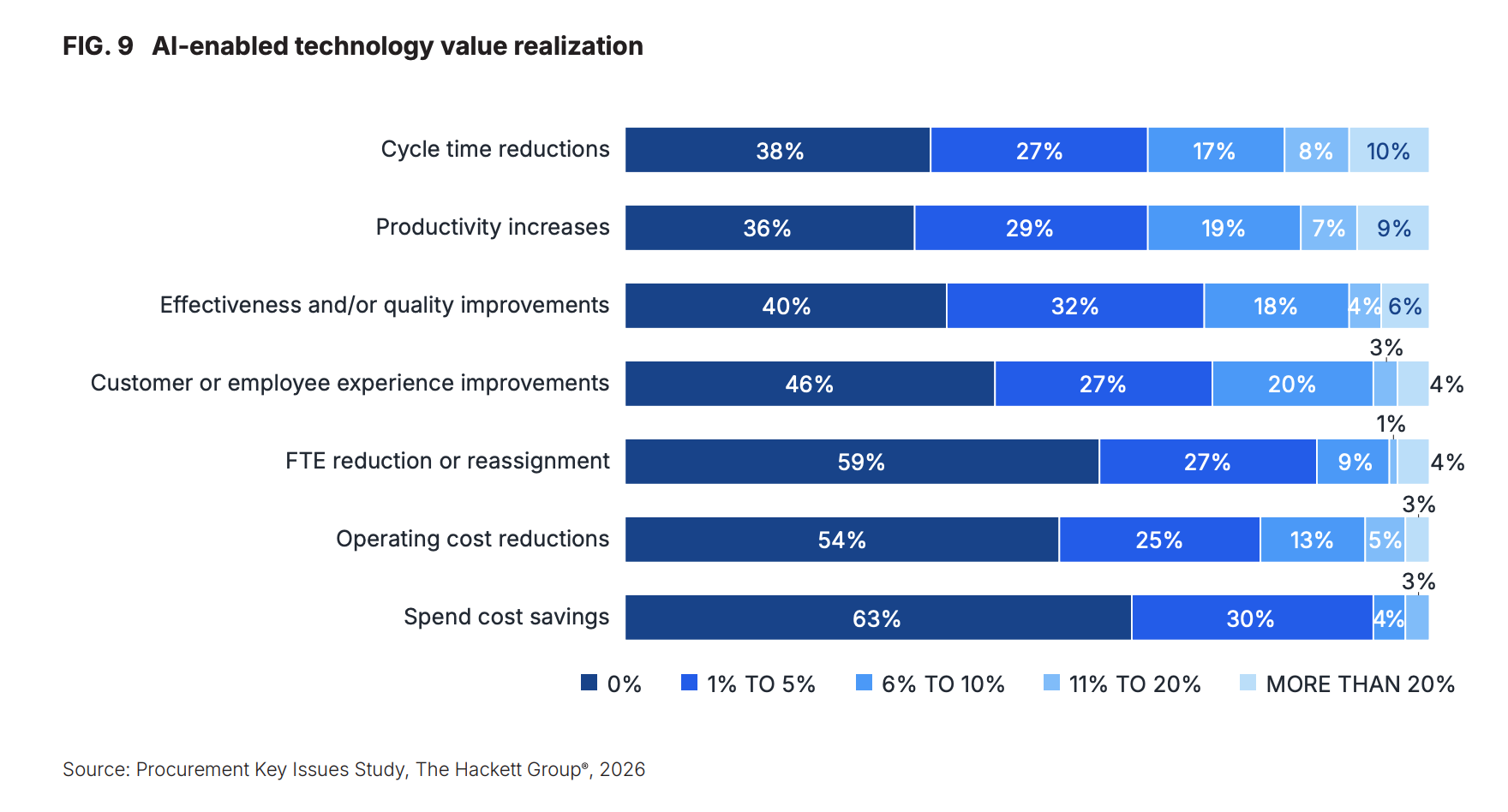
For a function judged on savings, that split hides where AI already pays off. Leading teams are changing what AI in procurement is aimed at, not just which tools they buy.
"Procurement is moving beyond isolated digital improvements and beginning to confront what AI really changes: how work gets done. The focus is shifting to redesigning processes, roles and decision-making so AI can deliver measurable value, not just incremental efficiency."
—Amy Hillcox, Senior Research Director, Procurement Applied Intelligence, The Hackett Group
Those teams name the outcome AI should move, such as supply continuity, then pilot before scaling. Success then means supply holds when a supplier fails, not that a task is completed faster.
What's missing is visibility and proof of return. Only 42% of leaders can see supply chain risk beyond tier one, so for most companies, supplier risk monitoring stops where Nissan's did in 2021. Meanwhile, in another survey, 55% of chief supply chain officers were unclear on the return from their AI investments, even as AI took 67% of supply chain digital spending.
What Keeps AI in Procurement From Protecting Revenue?
By the usual measures, AI in procurement is working. Buyers draft, negotiate, and close faster. But those gains lift individual output and then fade at the team level, and only 36% of chief procurement officers are very confident they can redesign roles and processes around AI.
Procurement automation is being added to processes and systems that were never built to act on what it produces, so faster individuals don't add up to a more resilient function.
Here's a closer look at the three places where AI in procurement stops short:
- Supplier Signals Split Across Systems: Spend data, supplier performance, and risk alerts each live in a different tool. On its own, each one can look fine, and the problem only shows when they're read together. Because separate teams bought each tool, no one owns connecting them. In contract work alone, 72% of organizations use multiple tools, and only 7% use a single integrated one. The fix is a layer that reads across existing systems rather than replacing them, so supplier decisions are made against the full picture.
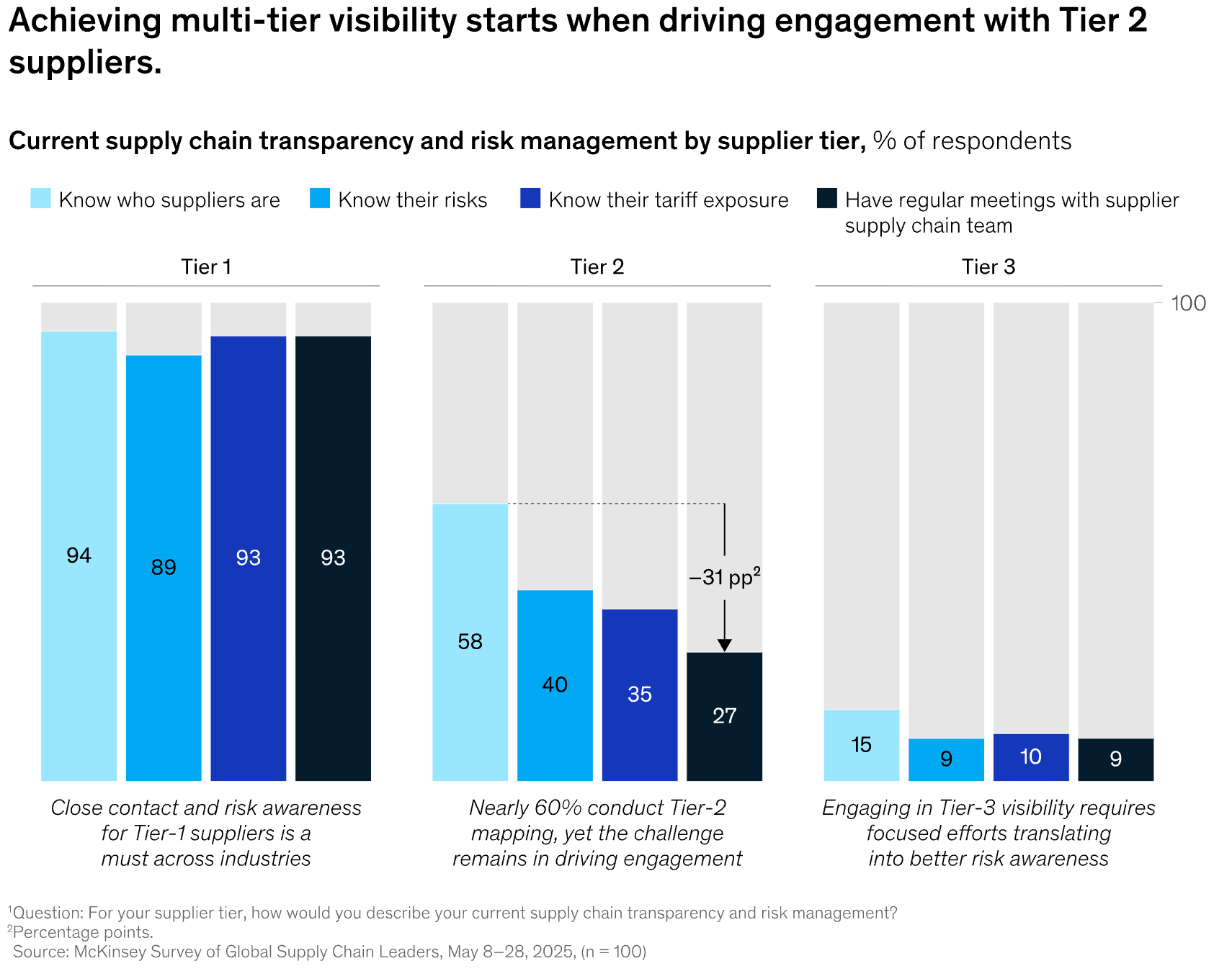
- Supplier Risk Tracked as a Scorecard: Companies often review supplier risk on a fixed schedule, and only for the tier-one suppliers they have contracts with. The suppliers behind them go unchecked, so a problem there may first show up as a late delivery. Many companies now map their tier-two suppliers, but few stay in regular contact with them, leaving supplier risk monitoring thinnest where visibility is lowest. The fix is continuous monitoring beyond tier one, with action thresholds set before a supplier is in trouble.
- No Orchestration Layer Between AI, People and Systems: When AI flags a risk, there's often no one assigned to act on it, so the alert goes nowhere. That's because most AI arrives as a feature inside an existing platform. About 69% of organizations use AI this way, mostly for procurement process automation such as purchase orders, and only 12% have scaled it. The fix is an orchestration layer, with roles and decision rights redesigned so every AI output reaches someone who can act on it.
The scorecard challenge is the easiest of the three to see in the data. As the chart below shows, risk awareness drops from 89% at tier one to 40% at tier two and 9% at tier three, so a scheduled scorecard never reaches the suppliers furthest from view.
Next, we'll walk through how three leading enterprises closed each of these gaps and turned AI in procurement into protection for supply and revenue.
Schneider Electric Turned Scattered Supplier Data Into One Picture
Schneider Electric runs procurement across roughly 50,000 suppliers, with major hubs in North America, Europe, India, and China. At that scale, supplier signals split across systems were hard to avoid. Spend, supplier performance, risk signals, and contracts sat in separate systems, so negotiations often started from spreadsheets and assumptions.
The data problem ran deep. Schneider operates multiple ERP systems, a single supplier can appear under a dozen names, and one component can carry 1,520 different part numbers.
Chief Procurement Officer Ard Verboon's view is that the data doesn't have to be perfect, because AI can already work with good-enough data. So rather than cleaning every record first, Schneider uses generative AI to interpret, categorize, and harmonize the data for spend analytics and risk planning, without manual clean-up from R&D or IT.
That layer sits at the core of Schneider's AI in procurement. Predictive analytics reads across it, turning contract renewals from reactive admin into strategic decisions.
"It connects the dots across spend, supplier performance, risk signals, and contracts (which are often spread across multiple systems) and turns that into actionable intelligence."
—Ard Verboon, Chief Procurement Officer, Schneider Electric
In practice, teams now enter negotiations with a fact base, knowing where demand is shifting, where pricing is drifting, which sites are exposed and which alternatives are viable. When disruption hits, the system recommends which suppliers might be affected, which orders to reroute and which alternatives can step in. For Verboon, that speed is the point, since the company that acts first secures capacity and avoids the disruption.
The approach builds on a track record. An earlier system that used AI for supply chain optimization, adjusting safety stock, minimum order quantities, and lead times in real time, saved more than €100 million. In 2026, Gartner ranked Schneider first in its Global Supply Chain Top 25 for a fourth straight year, citing its use of generative and agentic AI to support human decision-making.
Schneider didn't fix its separate systems. It built a layer that reads across them, so supplier signals split across systems now come together in one picture before any decision is made.
Why Did General Motors Map Suppliers It Had No Contract With?
General Motors works with roughly 18,000 suppliers worldwide. For years, it knew its tier-one suppliers well and the companies beneath them barely at all. The chip shortage exposed the cost. In 2021, it forced production cuts at eight GM facilities, and the company halted US truck production again in 2022.
A scorecard couldn't address the challenge. The risk sat with sub-tier suppliers GM had no contract with, whose networks are protected by NDAs and treated by tier-one suppliers as a competitive advantage. So in 2022, GM built the map with its suppliers, offering support rather than issuing a requirement. It has since increased the number of suppliers it monitors tenfold.
The result is supplier risk monitoring built from four connected tools. SupplyMap traces relationships from direct suppliers down through the tiers that feed them. Risk Intelligence uses AI to classify thousands of daily public posts for risks such as natural disasters, while SupplyHealth watches thousands of supplier sites for warning signs. When a risk surfaces, SupplyAlert routes it to the people who can act before it escalates.
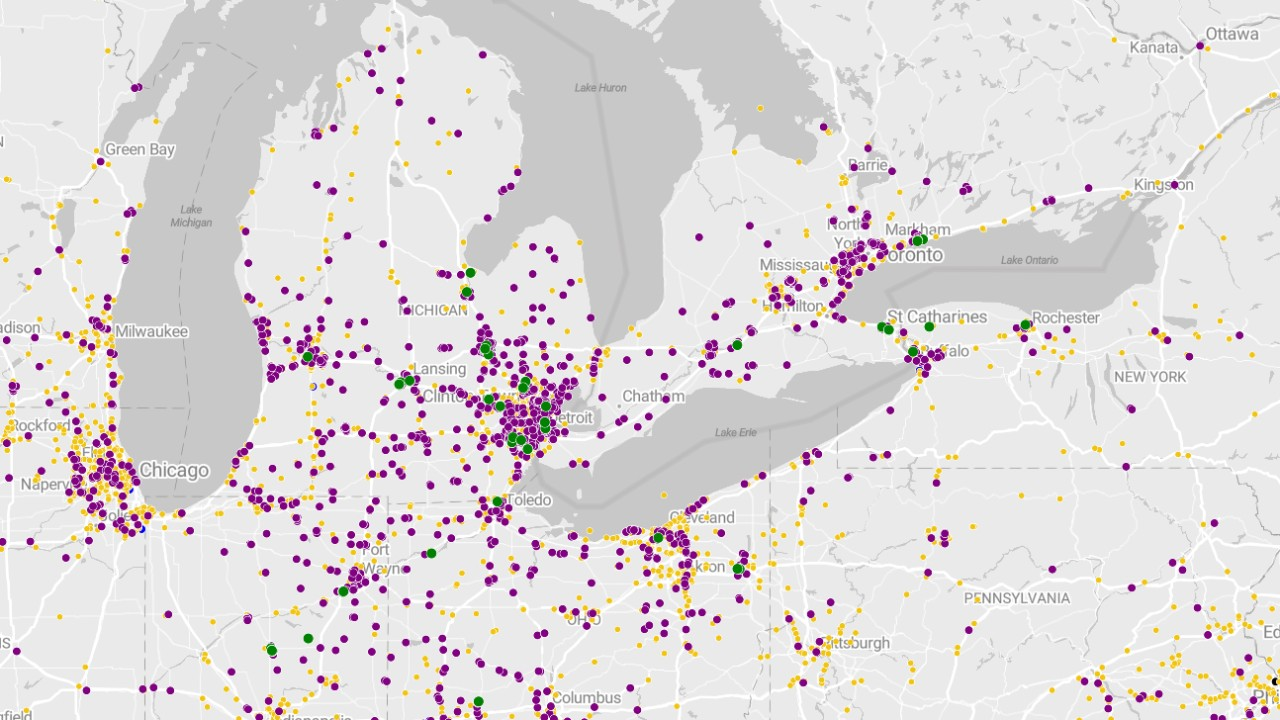
Even this slice of the map shows hundreds of supplier sites across the Great Lakes region, clustered around Detroit, Chicago and Toronto. Because SupplyMap covers direct suppliers and the levels that feed into them, the team can see where risk may occur before it reaches a GM plant.
"We started asking ourselves, 'How would a human actually work through that supply chain in a way that they can find those needles in a haystack to prevent a disruption?' You really quickly get to a point where you realize that a human can't do that effectively."
—Sean Gaskin, Director of Systems Engineering, General Motors
That's AI for supply chain optimization measured in production that didn't stop. In 2025 alone, GM says the system prevented at least 75 factory stoppages. Before Hurricane Helene hit North Carolina in September 2024, it had already flagged that Auria Solutions, which makes carpet for GM's full-size SUVs, would take a direct hit.
When the plant lost the water it needs to cut carpet, GM sent teams to help drill a well. The same tools helped GM avoid stoppages when China throttled rare earth magnet exports, and they can give it days or a week of warning on unexpected snags.
GM moved beyond supplier risk tracked as a scorecard, and that's where AI in procurement starts protecting revenue, not just trimming cost. A scorecard shows how a supplier performed, while a map shows what that supplier depends on.
How Did Lenovo Build an Orchestration Layer Between AI, People and Systems?
Lenovo is an $83 billion technology manufacturer whose supply chain spans thousands of suppliers and more than 30 manufacturing sites. A few years ago, it had the data but not the connections. Siloed operations and limited real-time information were holding back its ability to anticipate and respond to supply risks across roughly 2,000 international suppliers.
Lenovo's answer was Supply Chain Intelligence, a platform that pulled more than 800 data sources, close to 80% of its supply chain inputs, into one place. The bigger shift was what happened after AI found something.
When bad weather threatens a customer order, the system sends an alert, offers AI-generated alternatives for shipping it another way, and lets a decision-maker choose. Once they do, it automatically notifies every relevant team.
That sequence of AI recommending, a person deciding, and the system carrying the decision through is what most AI in procurement lacks. Lenovo has since evolved it into iChain, a continuously learning orchestration system that coordinates its suppliers and sites. Even with agentic AI in place, the company keeps people at defined decision points and runs multiple monitoring systems to check AI outputs before they reach operations.
"Because of this long history, we understand clearly where human intervention is needed, and we step in at those points."
—Jammi Tu, Senior Vice President and Group Operations Officer, Lenovo
The payoff shows up on both sides of the ledger. Lenovo says the platform cut decision-making time by 60%, lifted on-time-in-full delivery by 5%, and reduced manufacturing and logistics costs by around 20%, all while contributing to a 4.8% revenue increase. With iChain, network simulations that once took two to three weeks now take two to three hours, and Lenovo ranked fifth in Gartner's 2026 Supply Chain Top 25, its highest position yet.
Lenovo didn't add another AI tool. It built the orchestration layer between AI, people, and systems, so every signal AI finds ends with someone who can act on it.
Why AI in Procurement Has to Protect Revenue, Not Just Cost
When conflict escalated in the Middle East in early 2026, Nissan's Americas team knew its exposure within hours. In 2021, the same team had halted production for nearly three weeks without seeing where the shortage began. What changed was a supplier map built for compliance, on data that was hard to justify until it became a "gold mine."
That's the pattern behind AI in procurement that protects revenue. Its value materializes as disruptions that never happen, which is exactly what a savings metric doesn’t reflect. Leaders must increasingly prioritize it: 73% of companies report losing money to supplier disruption, and boards now rank revenue protection and top-line growth close behind cost savings as the returns they expect from AI.
Measured on speed and savings alone, procurement automation will keep looking like a cost line. The question isn't whether to add another AI tool. The question organizations must ask is whether anything already in place would flag a sub-tier supplier and route it to someone who can act before supply stops.
.avif)
Frequent Asked Questions
Why does AI in procurement need to protect revenue?
Supply disruptions hit revenue, not just costs. In fact, 73% of companies report losing money to supplier disruption, and Honda's late-2025 chip shortage cost it about 110,000 vehicles of North American production.
How can I assess the risk of a supplier?
Start by looking beyond the scorecard, which shows how a supplier performed but not what it depends on. Effective supplier risk monitoring reaches past tier one, updates continuously, and sets action thresholds before a supplier is in trouble.
How can AI be used in supply chains?
The highest-value use of AI for supply chain optimization is seeing beyond tier one, where only 42% of leaders have risk visibility. GM mapped its sub-tier network with AI and prevented at least 75 factory stoppages in 2025.
Is AI a type of automation?
AI is not the same as automation. Procurement automation makes an existing step faster, while AI can read across systems, flag risks, and recommend actions. Without redesigned roles and processes, faster individual output doesn't automatically make a team more resilient.
How is AI used in procurement?
AI in procurement often starts with transactions like purchase orders and invoices. Leading teams go further. Schneider Electric uses it to unify supplier data across ERP systems, and GM uses it to scan thousands of daily posts for supply risk.


.svg)


_0000_Layer-2.png)

