
How AI Product Management Ends the Loudest-Voice-Wins Problem
AI product management is transforming how teams prioritize features—replacing stakeholder politics with customer evidence. Here's a practical framework for building the system.
PMs at enterprise organizations use AI to analyze hundreds of customer reviews in minutes, building roadmaps around documented pain points.
61% of product managers already use AI, but few have connected feedback channels to prioritization decisions. Those who have report 30% higher launch success rates.
Connecting AI-analyzed feedback to product analytics reveals which requests actually correlate with retention and which are noise.
Lucas Carval was experiencing a pain point every product manager knows all too well. As Head of Product at Mention, the media monitoring platform, he was drowning in customer feedback scattered across G2 reviews, Capterra ratings, NPS surveys, and churned customer interviews. His team spent hours combing through hundreds of comments, trying to identify patterns for their Q3 roadmap. The loudest internal voices kept winning prioritization battles, while actual customer pain points sat buried in spreadsheets. Like many PMs exploring AI in product management, Carval wondered if there was a better way.
Lucas fed six months of customer feedback into an AI analysis tool, asking it to categorize sentiment and surface recurring themes. What took weeks of manual review condensed into a ten-minute report. The data revealed a clear pattern: ease-of-use issues were driving churn, not the feature gaps his sales team had been pushing. Armed with documented evidence, Carval successfully built Mention's Q3 and Q4 roadmap around the friction points customers actually described.
Carval's experience points to a fundamental shift in how product decisions get made. For decades, roadmap prioritization has been a political exercise, but AI product management leverages customer evidence for a more data-driven approach. But the technology alone isn't enough. Companies that dump feedback into an AI tool and expect magic will be disappointed. Those seeing real results have built systematic pipelines: centralized feedback, automated analysis, weighted scoring, and behavioral validation. This guide walks through each phase so you can replicate their success.
“Rather than relegating generative AI to a sidebar function, we are witnessing the shift from AI as an “add-on” to AI as a core part of the workflow. It is about building systems where AI serves as a practical, integrated, and democratized force, putting data and insights into the hands of those who understand the business best.”
—Ben Canning, Chief Product Officer, Alteryx
The Problem Hiding in Your Feedback Channels
Product managers have more customer data than ever, yet struggle to translate support tickets, analytics dashboards, NPS surveys, and sales call notes into confident decisions. They’re also under more pressure than ever, with 84% of product teams concerned that their product won’t succeed. Increasing the potency of those decisions is crucial.
But without systematic analysis, the loudest stakeholder wins. Features are built because a sales rep escalated a deal or an executive had a bad customer call, not because the data pointed that way. Perhaps most tellingly, in a survey of 600 product managers, the majority cited “influencing stakeholders” as their primary challenge.
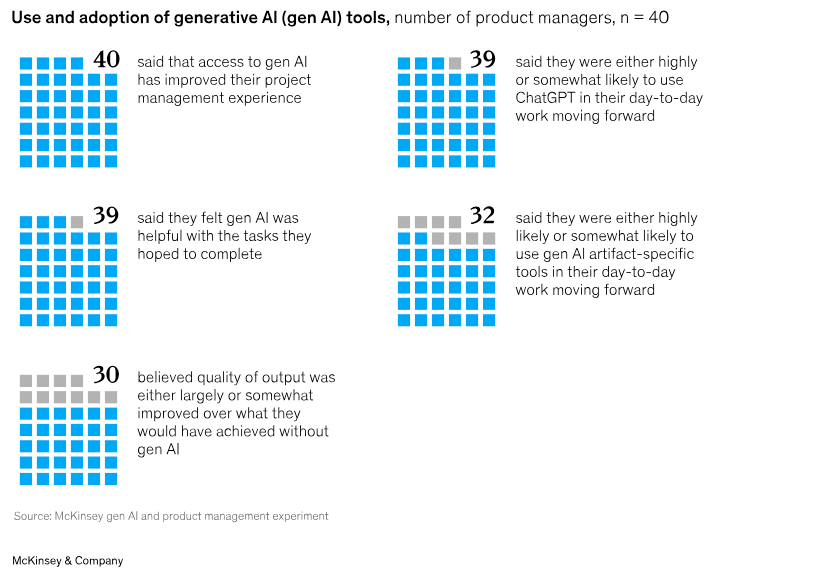
The good news is that AI can be a boon to product managers. In 2024, McKinsey found that professionals using AI in product management reported a 5% faster time-to-market and a 40% increase in productivity. For product teams that still manually tag feedback and debate priorities in spreadsheets, these efficiency gains remain untapped.
Before You Build: Pitfalls That Derail AI in Product Management
Before implementing any AI product management system, acknowledge the failure modes that derail most attempts. MIT Sloan research on AI governance emphasizes that successful implementations require clear oversight structures from day one. These pitfalls apply whether you're building custom solutions or deploying off-the-shelf product management AI tools.
- Data quality determines output quality. If your feedback sources are incomplete or biased toward vocal customers, AI will amplify those flaws. Plan quarterly audits and actively seek feedback from customer segments that rarely complain.
- Transparency prevents backlash. When you shift to data-based prioritization, stakeholders who previously won through influence may resist. Document criteria explicitly. "40% of enterprise users mentioned this pain point" is harder to argue with than "I think this is important."
- Humans decide, AI recommends. MIT Sloan's research on intelligent choice architectures defines the best systems as those that "present choices for and with decision makers.” Build weekly review cycles where PMs validate AI outputs.
- Start narrow, expand after wins. Don't roll out company-wide on day one. Pilot with a single product line and demonstrate value before asking the organization to change how it makes decisions.
Build Your Single Source of Truth
Before implementing any AI product management system, acknowledge the failure modes that derail most attempts. MIT Sloan research on AI governance emphasizes that successful implementations require clear oversight structures from day one. These pitfalls apply whether you're building custom solutions or deploying off-the-shelf product management AI tools.
- Data quality determines output quality. If your feedback sources are incomplete or biased toward vocal customers, AI will amplify those flaws. Plan quarterly audits and actively seek feedback from customer segments that rarely complain.
- Transparency prevents backlash. When you shift to data-based prioritization, stakeholders who previously won through influence may resist. Document criteria explicitly. "40% of enterprise users mentioned this pain point" is harder to argue with than "I think this is important."
- Humans decide, AI recommends. MIT Sloan's research on intelligent choice architectures defines the best systems as those that "present choices for and with decision makers.” Build weekly review cycles where PMs validate AI outputs.
Start narrow, expand after wins. Don't roll out company-wide on day one. Pilot with a single product line and demonstrate value before asking the organization to change how it makes decisions.
Success looks like this: all customer feedback is searchable in a single system, with source attribution visible on each item.
Turn Noise into Weighted Scores
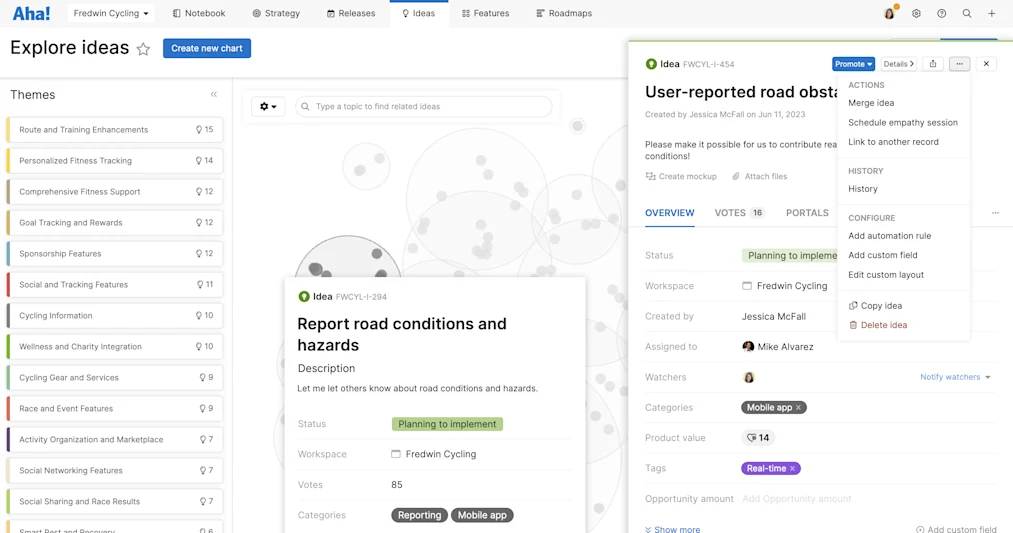
With feedback centralized, the next step is automating the analysis that previously required hours of manual review. Raw feedback is useless until it's categorized, quantified, and connected to business outcomes. This is where generative AI for product management begins to compound your team's capacity, transforming raw feedback into structured insights. Product management AI tools like Productboard or Aha! offer native feedback collection and AI-powered tools for analyzing and exploring customer feedback.
This phase builds the analytical engine that replaces subjective debate with documented evidence.
- Select your analysis approach. Purpose-built platforms like Productboard Pulse or Thematic offer turnkey sentiment analysis and theme detection. Teams with specific needs can build custom pipelines using Claude or GPT-4 to classify feedback against proprietary taxonomies. The build-vs-buy decision depends on volume: fewer than 500 feedback items monthly often works fine with manual tagging; beyond that, automation pays for itself.
- Define your category taxonomy. Start with 5-7 categories that map to your product's value drivers. A B2B SaaS tool might use: Reliability, Ease of Use, Feature Gaps, Integration Requests, Pricing Concerns, and Onboarding Friction. Resist the urge to over-categorize—too many buckets dilute signal.
Calibrate with historical data. Feed 3-6 months of past feedback through your system before trusting it with live data. Target 85% agreement between AI classification and human review. Below that threshold, refine your taxonomy or prompt engineering until accuracy improves.
- Build your scoring criteria. Define four to five factors that determine what gets built: Customer Impact (how many users affected), Business Value (revenue or retention implications), Effort (engineering complexity), and Strategic Fit (alignment with company direction). Weight each factor explicitly—Impact at 35%, Business Value at 30%, Effort at 20%, Strategic Fit at 15%—so the math is auditable.
- Connect AI outputs to scores. Map your automated analysis directly to scoring inputs. Feedback volume feeds Customer Impact. Sentiment intensity informs Business Value. Keyword clustering reveals Strategic Fit. The goal is a ranked backlog where position reflects documented evidence.
- Validate before committing. AI generates the ranked list; humans validate the top 20 items before anything enters a sprint. This checkpoint catches misclassified edge cases and ensures PMs maintain decision authority. The system recommends; the team decides.
“The playing field is poised to become a lot more competitive, and businesses that don’t deploy AI and data to help them innovate in everything they do will be at a disadvantage.”
—Paul Daugherty, CTO, Accenture
Close the Say-Do Gap
Customers say one thing and do another. The final phase of building a robust AI product management system closes this gap by connecting stated preferences to observed behavior. This behavioral validation layer is what separates mature AI implementations from basic sentiment analysis.
- Integrate product analytics. Connect your prioritization system to behavioral data: feature adoption rates, user drop-off points, session frequency, retention correlations. Whether you use Amplitude, Mixpanel, Pendo, or built-in analytics, the key is bridging what customers request and what they actually use.
- Cross-reference say versus do. This analysis reveals four quadrants: High requests plus low adoption suggests validation is needed before major investment. Low requests, plus high retention, reveal hidden gems worth elevating. High requests plus high usage confirm clear winners. Low requests plus low usage indicate table stakes that shouldn't dominate the roadmap.
- Build validation loops. After shipping a feature, track adoption metrics and feed results back into your scoring weights. If high-scoring features consistently underperform on adoption, adjust how you weight stated preferences. This continuous learning transforms your system from a static framework into an adaptive engine.
The Roadmap That Defends Itself
How do you know if your AI product management system is working? Track three metrics: time spent on prioritization activities (target 25-30% reduction), frequency of roadmap disputes escalating to leadership (should decrease as decisions become traceable to data), and post-launch feature adoption rates (should improve as you build what customers actually need versus what they say they want). These are the proof points that justify continued investment in AI for product managers.
Back at Mention, Lucas Carval no longer dreads quarterly planning. When stakeholders push for pet features, he pulls up sentiment analysis showing which pain points customers actually describe. When executives question why a request ranked lower than expected, he walks through behavioral data showing that similar features saw minimal adoption. The system transforms arguments from political battles into productive debates about data.
The barrier is the organizational discipline to centralize feedback, define transparent criteria, and commit to letting data inform decisions. Start this week: audit your feedback sources. List every channel where customer input lives. You may be surprised by how much signal is sitting unused in systems you already own.
.avif)


.svg)


_0000_Layer-2.png)

