
AI for FP&A: Lessons from Cisco, Microsoft & American Airlines
Median AI ROI in finance sits near 10%, even as adoption surges. Cisco, Microsoft, and American Airlines show what it takes to break through: architecture first, automation second.
Median AI ROI in finance sits near 10%, even as 72% of finance teams have adopted AI tools, a gap traced to fragmented planning architecture.
Generative AI tools like Claude are shifting the FP&A analyst role from data preparation toward strategic reasoning, but only deliver value when paired with integrated forecasting and ERP systems.
Architecture redesign turns AI for FP&A from a reporting accelerator into a capital allocation tool, and that shift is where enterprise finance ROI compounds.
In global corporations, treasury teams rarely struggle with a lack of data. More often, the problem is how fragmented that data becomes across markets, systems, and reporting cycles. At The Coca-Cola Company, managing foreign exchange exposure across more than 200 markets meant constantly tracking currency movements while explaining their financial impact to the CFO and board.
Until recently, much of that analysis was highly manual. Treasury teams relied heavily on spreadsheet-based workflows to assess foreign exchange (FX) risk and evaluate hedging decisions, which made scenario modeling slower and limited real-time visibility into currency exposure and cash-flow implications.
The turning point came when Coca-Cola’s treasury team redesigned its treasury architecture (with banking partners including Citi) to integrate AI financial forecasting and automate global data aggregation. This modernization reduced manual workload by about 14%. Such an AI for FP&A (financial planning and analysis) integration also allowed treasury outputs to directly influence capital allocation and risk management decisions.
“A dynamic FX risk management programme is crucial in today’s volatile global environment, ensuring that it is aligned with a company’s core and evolving KPIs.”
—Matthew Novack, Director of Corporate FX Sales at Citi
However, unlike Coca-Cola, many companies that adopt AI for FP&A do not realize the financial impact of their initiatives. And this challenge is not limited to treasury. Across FP&A functions, AI is now being applied to revenue forecasting, expense planning, scenario modeling, and AI cash flow forecasting.
But in many cases, these insights remain confined to reporting rather than shaping real business decisions. In fact, according to Boston Consulting Group, the median AI return on investment (ROI) in finance is around 10%, while only a minority of companies achieve returns exceeding 20%.
For example, AI financial forecasting models can improve demand projections and cost visibility, while AI for financial planning can accelerate budgeting and variance analysis. Yet when these outputs are disconnected from capital allocation, hiring decisions, or operational planning, their impact remains incremental rather than transformative.
This has led many finance leaders to ask: How can we use AI in FP&A effectively? Industry trends showcase that it involves redesigning forecasting architectures, integrating data systems, and restructuring decision workflows.
More importantly, tools related to AI for financial planning should be able to explain results in ways that teams can easily understand. What many are looking for is an Excel sheet with a brain.
“I want my team to be talking about why the numbers are what they are, and what we should do about it, and not spending their time trying to figure out what the numbers are.”
—Aaron Alt, CFO at Cardinal Health, a distributor of drugs and medical products.
In this article, we’ll explore why many AI for FP&A initiatives deliver only incremental returns and how companies like Cisco, Microsoft, and American Airlines redesigned their financial architecture to turn forecasts into real financial impact.
The Rising Importance of AI for FP&A as CFOs Seek Better Forecast Accuracy and Productivity
Finance operations today operate in a highly uncertain environment, with faster market changes, higher capital costs, and shorter planning cycles. Because of this, finance teams are expected to do more than just report results; they need to provide forward-looking insights that help organizations plan ahead and make better decisions under uncertainty.
For CFOs and finance leaders, this means adopting new tools and approaches that enable faster, more informed decision-making.
“The goal is not to adopt more AI, but to apply it where it measurably reduces friction, improves clarity, or shortens decision cycles.”
—Ashok Manthena, researcher in Finance AI and Founder of ChatFin
Boards and executive teams now expect AI financial forecasting tools to deliver predictive visibility rather than simply explaining past performance variances. Generative AI tools like Claude are already creating value in FP&A by automating workflows such as variance analysis, earnings summarization, and scenario modeling, which reduces reporting cycles and accelerates insight generation.
A survey found that 88% of CFOs are already using at least one agentic AI tool in their accounting and finance processes, highlighting how quickly AI adoption is becoming standard across enterprise finance. At the same time, generative AI tools are already delivering productivity improvements across finance workflows. A 2025 BCG survey found that almost half of respondents reported “transformative impact” from using AI in risk management, revenue/spend data classification, and financial forecasting.
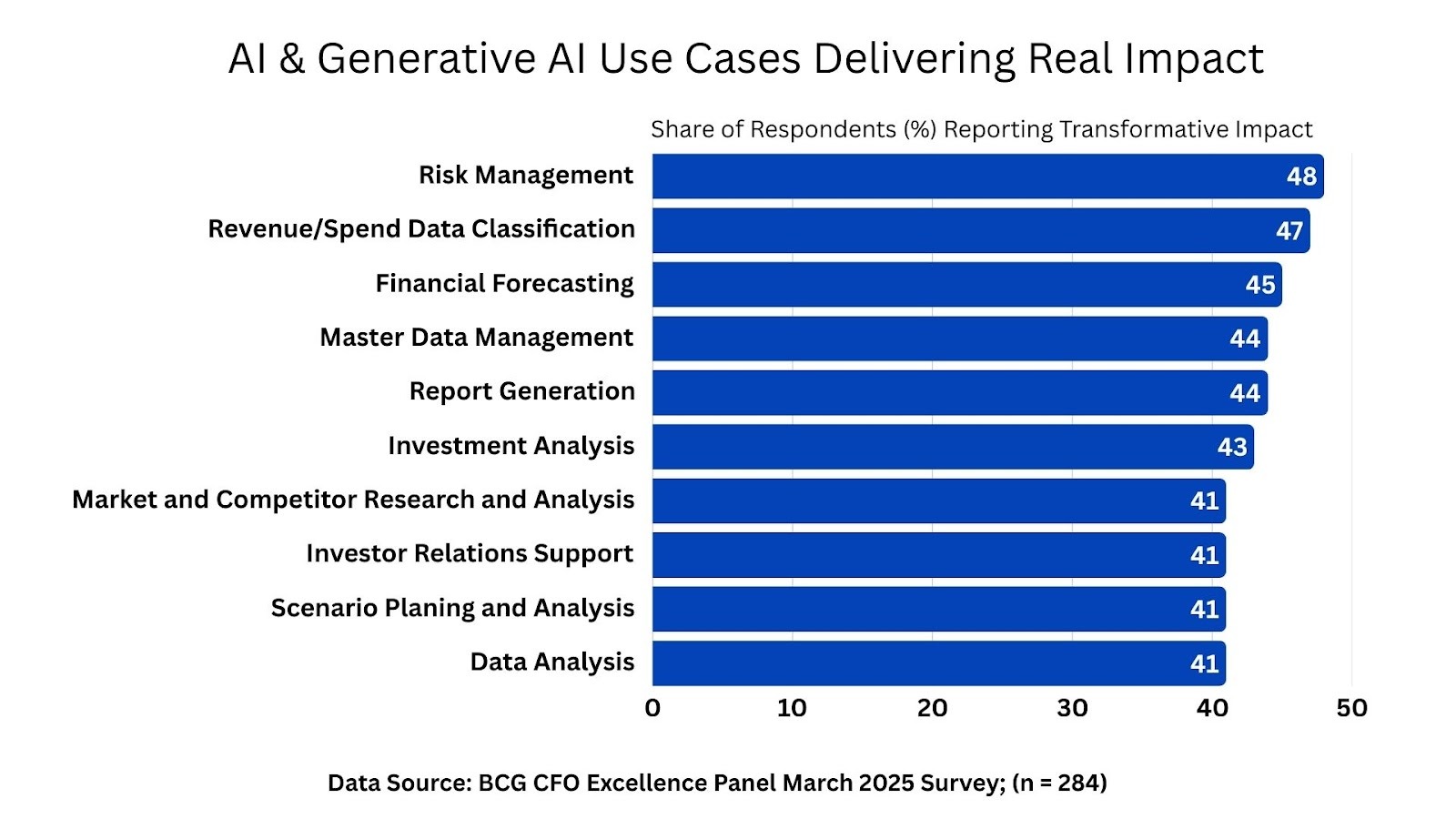
However, while adoption and productivity benefits are rising, measurable return on investment still varies widely across finance functions, indicating that many organizations are still in the early stages of translating AI for financial planning tools into sustained financial impact.
Key Barriers to Scaling AI Financial Forecasting in Enterprise Finance
The challenge of using AI for FP&A is rarely a technical capability issue; rather, it comes from organizational design. Many AI for FP&A initiatives are introduced into financial planning systems that were never redesigned for AI-driven prediction and real-time decision-making. As a result, even when efficiency improves slightly, the deeper financial impact remains limited.
Here are four structural barriers to integrating AI in finance:
- Disconnected Planning Systems: Effective forecasting requires data from revenue, cost, operations, workforce, and treasury systems, including sales, pricing, supply chain, procurement, and human resources, to be integrated within a unified planning environment. When AI cash flow forecasting tools run on disconnected data, they may generate insights, but those insights often lack the authority to drive real decisions. In fact, only 35% of companies use external market data, and only 18% use additional data types, such as customer activity data, real-time demand signals, and other nontraditional external indicators that can serve as leading signals of business performance. As a result, limited integration and scaling prevent AI from meaningfully influencing enterprise financial decisions.
- Efficiency Gains Not Redeployed into Business Planning: Analysts may spend less time preparing data, but that extra time is not always redirected to activities such as scenario modeling or capital planning. Research shows that companies that embed analytics directly into decision-making processes are 2.5 times more likely to achieve significant business impact.
- Automation Without Forecast Architecture Redesign: Many finance teams are already automating their finance workflows with AI for FP&A. In fact, about 40% of finance activities can already be fully automated. However, adding AI financial forecasting to legacy planning systems may speed up reporting, but it doesn’t necessarily lead to better decisions. Real value comes when companies redesign their forecasting models and planning processes, not just automate existing workflows.
- Governance Without Decision Authority: Weak governance can also limit the impact of AI in FP & A. Without clear governance, finance leaders are often hesitant to rely on AI outputs for important decisions. Many companies still lack standard processes for model validation, monitoring, and escalation. In fact, only 18% of organizations have an enterprise-wide AI governance council, and just one-third require technical teams to have AI risk-mitigation skills. As a result, AI financial forecasting is frequently overridden manually, which slows decision-making and reduces trust.
How Generative AI Tools Like Claude Improve AI Financial Forecasting Insights
Before we look at how large enterprises are scaling AI for FP&A, let’s take a closer look at how generative AI tools such as Claude are already supporting finance teams in day-to-day analysis and reporting.
Generative AI tools like Claude can support AI for FP&A by helping finance teams interpret financial data, summarize reports, and explain trends in clear language. Using Claude, analysts can upload datasets, earnings reports, or forecasting outputs and ask Claude to identify key drivers of variance, highlight risks, or generate concise explanations for leadership discussions.
Another advantage is its ability to work with large documents and spreadsheets. Finance teams can also use Claude Artifacts, a feature that lets users generate structured outputs such as tables, dashboards, or simple financial models in a separate workspace.
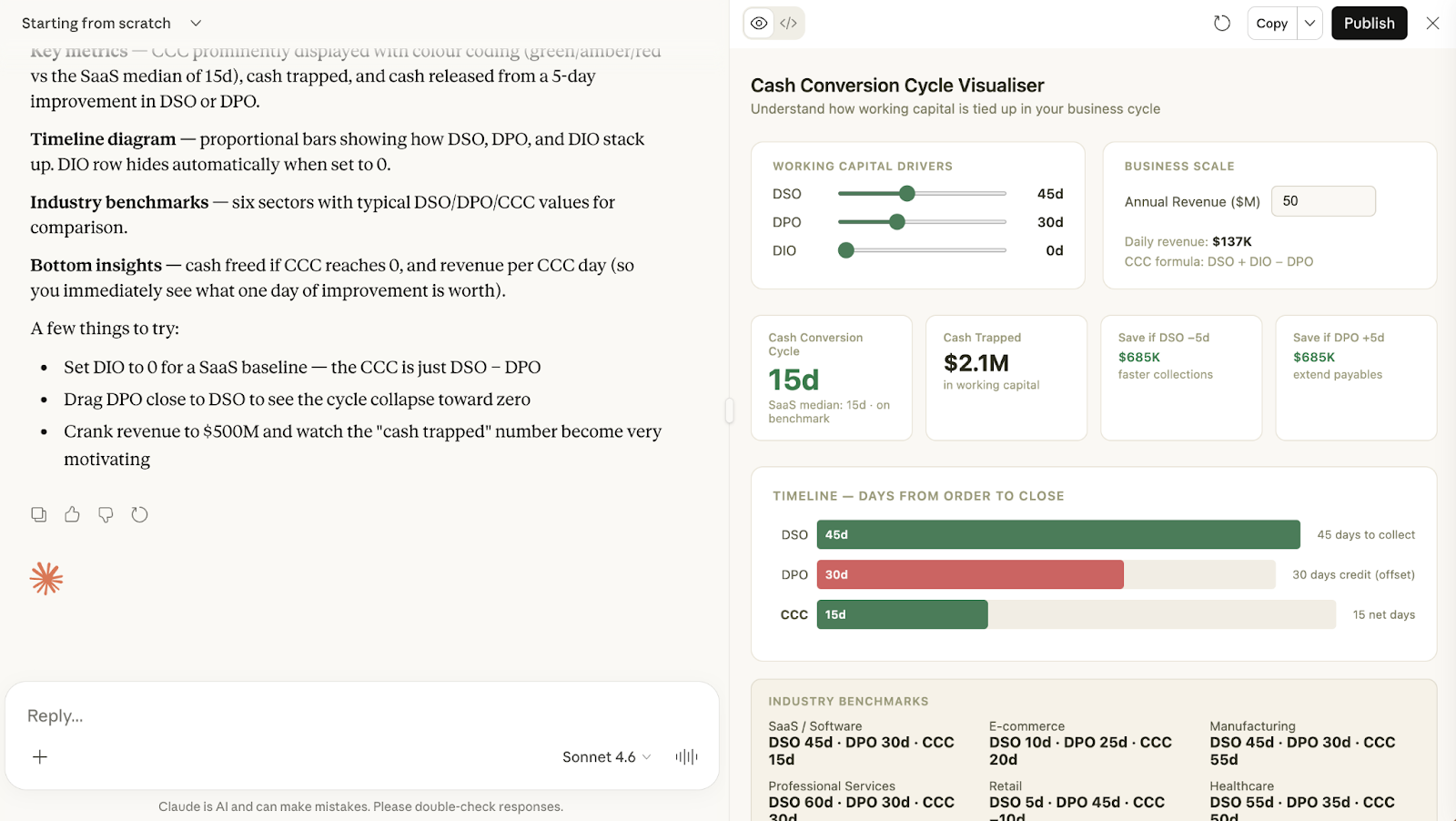
Interestingly, various Claude prompt libraries are emerging that help CFOs and finance teams perform FP&A tasks, such as forecasting, variance analysis, and scenario planning, more easily using structured AI prompts.
Such methods can help analysts quickly create summaries, visualize financial data, and refine assumptions. As a result, they can produce management commentary and structured analysis much faster than preparing reports manually.
However, tools like Claude are most effective when used alongside broader AI for financial planning systems. Forecasting models, ERP platforms, and treasury tools still provide the underlying financial data, while generative AI helps interpret the results and communicate insights clearly. In this role, Claude serves less as a forecasting engine and more as a financial reasoning assistant, letting FP&A teams focus on strategic decision-making.
Next, we’ll walk through real-world examples of how large enterprises are applying AI for FP&A. These case studies show how Cisco Systems, American Airlines, and Microsoft addressed the structural challenges we discussed earlier by redesigning their financial architecture before scaling AI.
AI for Financial Planning at American Airlines: Building a Single Source of Truth for Treasury and Forecasting
American Airlines faced growing liquidity risks as fuel prices fluctuated, demand became more unpredictable, and the capital-intensive nature of airline operations added financial complexity.
Treasury and FP&A teams worked in separate systems and relied heavily on spreadsheets, with no real-time integration between planning and liquidity data across cash, collateral, foreign exchange (FX) exposure, and debt positions. This fragmented setup made forecasting less reliable and slowed capital allocation decisions, making it harder for finance leaders to respond quickly to changing market conditions.
To address these issues, American Airlines partnered with GTreasury to build an industry-first Collateral Management System. The platform integrated liquidity, debt, and treasury data — including collateralized debt, fleet management, cash management, forecasting, foreign exchange (FX) risk, and investments—into a single environment, creating a unified data foundation that supports advanced analytics and AI-enabled forecasting capabilities within the treasury platform.
Following the transformation, global cash visibility increased from about 65% to 99%, and treasury automation rose from around 50% to 90%. The treasury team also reclaimed up to 20% of the time previously spent on manual processes, allowing them to focus on more strategic work. The initiative was also named a finalist for the 2025 AFP Pinnacle Award for treasury innovation.
This AI for FP&A transformation demonstrates the importance of integrating planning and liquidity systems in financial forecasting. By creating a single source of truth across debt, fleet, and cash positions, American Airlines connected liquidity insights directly to planning decisions, allowing forecasting outputs to carry greater authority with finance leadership.
How Microsoft Improved AI Revenue Forecasting by Embedding AI into FP&A Workflows
Microsoft faced revenue-forecasting challenges because its global operations required significant manual reconciliation across business units in each forecast cycle. While reporting tools helped speed up the process, underlying data issues still caused friction, and forecasts often had to be validated multiple times across regions before reaching executives.
Without redesigning the underlying systems, adding more analytics or AI for financial planning tools would have simply accelerated reporting rather than improving forecast reliability or financial decision-making. Microsoft modernized its finance operations by integrating data platforms and machine learning into its forecasting processes, embedding AI directly into finance workflows across procurement, collections, and financial forecasting.
“AI is driving so much change at the company … saving us thousands upon thousands of hours.”
—Cory Hrncirik, Modern Finance Leader at Microsoft
Over time, Microsoft’s finance team expanded its use of AI from traditional machine learning in forecasting to a broader set of AI-driven finance workflows, improving efficiency and reducing reliance on manual, spreadsheet-based processes. Rather than simply accelerating reporting, this shift allowed Microsoft to streamline finance operations, improve data consistency, and enable faster, more reliable forecasting cycles.
AI for FP&A also increased CFOs' confidence in forecast outputs, while the efficiency gains were redirected toward scenario modeling and strategic financial analysis. As a result of embedding AI directly into its forecasting workflows, Microsoft achieved more accurate forecasts than traditional CFO-driven approaches, improving average error rates from 2.7% to 1.5%, while also dramatically reducing forecasting effort from approximately 100 people working for a month to just 2 people completing the process in 2 days.
AI for Financial Planning at Cisco Systems: Fixing Forecast Architecture Before AI Adoption
Cisco Systems faced growing forecasting challenges as it moved toward a recurring-revenue business model. Planning and reporting systems across business units were fragmented, and inconsistent data made it difficult to get a clear, consolidated financial view. Forecasting timelines also varied by region, which made it harder to produce consistent predictive insights. In this environment, deploying AI on top of these fragmented systems would likely have amplified inconsistencies rather than improving forecast accuracy.
To tackle this, Cisco redesigned and standardized its planning architecture before expanding predictive analytics across the organization. In May 2024, the company introduced Circuit, a secure, proprietary AI platform built on its own infrastructure and integrated directly into collaboration and workflow systems.
“If you put the right tools and processes in place but don’t focus on people, adoption will stall. Our goal is to give every employee the skills and confidence to bring AI into their daily work.”
—Gianpaolo Barozzi, Cisco’s 3P Chief Technology Officer.
Following this rollout, roughly 50,000 of Cisco’s more than 80,000 employees began using AI tools in their daily workflows, signaling large-scale adoption across the enterprise.
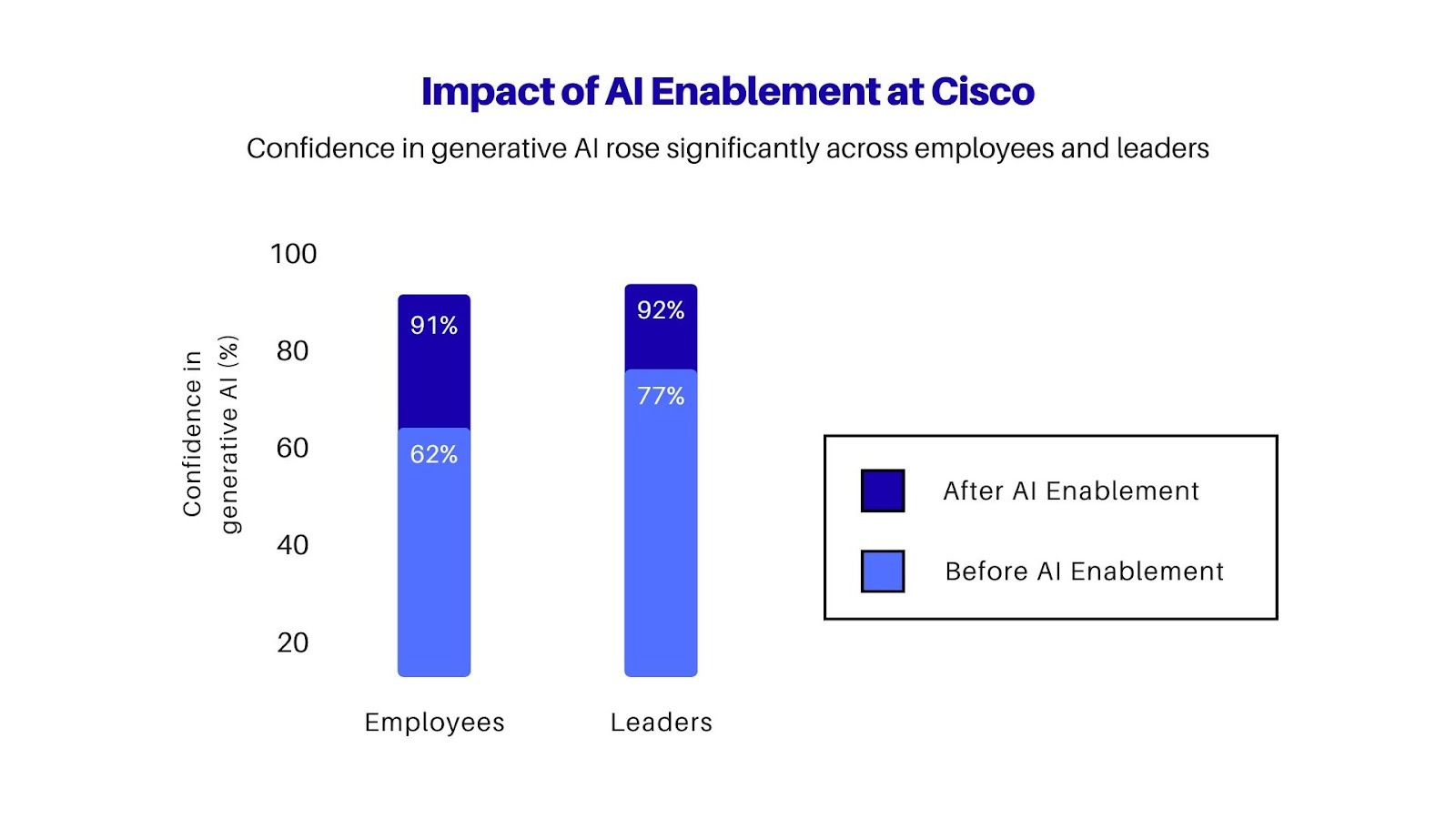
The AI for FP&A transformation highlights a structural lesson for AI adoption in finance. Rather than layering automation onto legacy planning systems, Cisco standardized its financial architecture first, allowing unified data models to provide consistent inputs for predictive workflows. Cisco also established strong governance by hosting AI for financial planning systems on its own servers to protect sensitive data.
AI Financial Forecasting Works Best When Decision Workflows Are Redesigned
The Coca-Cola Company’s transformation succeeded not just because it adopted analytics, but because it redesigned its treasury and planning workflows so insights could directly support capital allocation and risk decisions. The real change was not faster automation, but giving financial insights a stronger role in decision-making.
This reflects a broader AI for FP&A lesson for enterprise finance: structure matters more than simply adding new tools. Companies that redesign their forecasting processes and integrate analytics into decision workflows are more likely to see lasting business impact, while those that layer AI for financial planning tools on top of existing systems usually achieve only small efficiency improvements.
.avif)
Frequent Asked Questions
How did American Airlines improve cash flow forecasting and treasury visibility with AI?
American Airlines modernized its treasury and cash forecasting operations by integrating treasury and FP&A data streams into a unified platform. The transformation increased real-time cash visibility from approximately 65% to 99% and raised treasury process automation from roughly 50% to 90%.
How did Microsoft use AI to improve financial forecast accuracy?
Microsoft unified its financial data architecture across business units before scaling predictive analytics. Rather than layering automation onto existing legacy planning structures, the company embedded machine learning models directly into core FP&A workflows.
What role does governance play in achieving ROI from AI financial forecasting?
Governance is a prerequisite for structural ROI, not an afterthought. When organizations lack standardized model validation, monitoring, and risk-escalation paths, executives lose trust in AI outputs and resort to manual overrides, slowing decision cycles and reducing the strategic value of forecasting models.
What are the biggest barriers to scaling AI for FP&A beyond pilot automation?
Four structural barriers limit AI for FP&A impact: legacy planning architectures, disconnected planning and liquidity systems, efficiency gains not redirected to strategic analysis, and weak governance that prevents AI insights from influencing financial decisions.
Why do most enterprises see only 10% ROI from AI for FP&A despite widespread adoption?
Median AI ROI in finance sits near 10%, even as 72% of finance teams now use AI tools. The gap exists because most organizations deploy AI into legacy planning systems without redesigning forecasting architecture or data ownership models.


.svg)


_0000_Layer-2.png)

